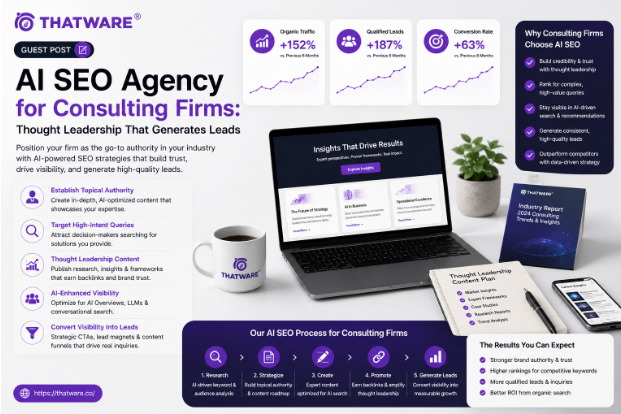
Consulting firms are, almost universally, terrible at marketing themselves online. This isn’t a controversial observation. Walk through the website of a mid-sized management consultancy or a boutique strategy firm and you’ll find: a generic services page, a few case study PDFs behind a contact form, a blog that was last updated in 2022, and some founding partner bios. Maybe a thought leadership whitepaper with a very generic title.
The irony is rich. These are firms that advise clients on strategy, on competitive differentiation, on market positioning. And they’re almost invisible in search.
Part of this is structural — consulting relationships are built on networks and referrals, so the urgency around inbound digital marketing has historically been low. Part of it is a category bias: consultants are often skeptical of marketing by nature. And part of it is that the thought leadership content consulting firms are best positioned to create — genuinely expert, insight-rich, perspective-driven — is exactly the kind of content that requires real effort to produce at SEO-friendly scale.
AI is changing this calculus. Not by making bad thought leadership content acceptable, but by making the production and distribution of genuinely good content more tractable for firms that have never had a real content operation.
The Search Opportunity Consulting Firms Are Missing
Here’s what the data shows when you look at how consulting and professional services firms appear in search results:
The transactional queries — “[service] consulting firm,” “[industry] strategy consultant” — are hard to compete for and often produce leads that aren’t well-qualified anyway. The much larger opportunity is in the informational and decision-stage queries: the research buyers are doing before they’ve defined what kind of help they need.
A B2B finance executive Googling “how to reduce supply chain costs without sacrificing quality” is a prospect for a supply chain consultancy. If that firm isn’t producing content that shows up for that query — and doing so in a way that demonstrates genuine expertise — they’re invisible to a prospect who is actively seeking the kind of knowledge their consultants possess.
This is the thought leadership SEO opportunity. And it’s enormous and largely uncaptured for most consulting firms.
The problem is that producing this content well requires combining two things that are hard to combine: genuine expertise (which consulting firms have) and SEO-optimized content production at scale (which most consulting firms have never built).
What AI Actually Does for Consulting Content
Let’s be specific. AI’s role in consulting thought leadership is not to generate the insights. The insights have to come from the people who actually do the work. What AI changes is the operational infrastructure around those insights.
Topic identification at scale. AI-powered analysis can map the full search landscape around a consulting firm’s practice areas — identifying which questions buyers are actually searching, which topics have underserved demand, which content opportunities competitors haven’t captured yet. This is analytical work that would take a human team weeks to do manually.
Content scaffolding and drafting. Consultants are often excellent at thinking and terrible at writing for a general audience. AI can draft from briefings, interview transcripts, or internal documents — giving the human expert something to react to and refine rather than starting from a blank page. This dramatically lowers the friction to publishing.
Distribution and authority building. Getting consulting thought leadership placed in the right publications — industry journals, business media, niche trade press — requires outreach at a scale that most professional services marketing teams aren’t equipped for. AI-assisted outreach, done by an agency with the right editorial relationships, can systematize this.
The Lead Generation Angle
Thought leadership for consulting firms isn’t just a brand awareness play. Done right, it’s a lead generation engine — and a particularly valuable one because the leads it produces are already educated, already aligned with your approach, and already predisposed to believe you know what you’re talking about.
Best AI SEO agencies for SaaS / eCommerce / B2B get written about a lot. What gets less attention is how the same AI-driven content strategy that works for SaaS applies to professional services — and in some ways, works even better, because the quality bar for competing in consulting thought leadership is lower than in consumer software.
A management consulting firm that commits to producing genuinely useful, search-optimized content around its core practice areas for 12-18 months will, in most cases, dominate the organic search landscape in its niche. The category isn’t competitive in the same way e-commerce or SaaS is. The opportunity is sitting there.
ThatWare has worked with professional services clients on exactly this kind of thought leadership SEO strategy — integrating AI-powered topical analysis with the kind of content production workflows that make sense for firms where the expertise exists but the content infrastructure doesn’t.
Practical Considerations for Consulting Firms Getting Started
If you’re running a consulting firm and you’re reading this thinking “we should be doing more of this” — here are the honest practical considerations.
Partner buy-in is non-negotiable. Consulting thought leadership only works if the people with the actual expertise are involved in content creation. This means getting senior consultants to contribute ideas, review drafts, and put their names on content. Firms where the partners are unwilling to do this will produce thought leadership that looks thin, because it will be thin.
Pace matters more than volume. One substantive, expert-driven piece per month beats five generic listicles every time. In a domain like consulting, where E-E-A-T signals are critical and Google’s systems are getting better at distinguishing genuine expertise from surface-level competence, quality is non-negotiable.
Build for the long game. The compounding nature of thought leadership SEO means the returns are back-loaded. Firms that expect significant inbound leads from organic search within three months will be disappointed. Firms that commit to 12-18 months of consistent, high-quality content production will have built something genuinely valuable.
The Best Agency for AI Search Optimization in This Space When it comes to professional services and consulting specifically, the agency selection criteria shift slightly from what you’d apply for an eCommerce or SaaS brand.
You want an agency that can work with complex, nuanced content. Consulting thought leadership deals with sophisticated concepts in specific professional domains — strategy, operations, finance, whatever the practice area. Agencies that primarily work in consumer categories won’t understand the audience or the editorial standards.
You want an agency with genuine editorial relationships in business media. Getting consulting insights into the right publications — not generic guest posting platforms, but the journals, newsletters, and media outlets that the firm’s target clients actually read — requires relationships, not just outreach automation.
And you want an agency that understands the longer conversion cycle of professional services buying. Content that works for consulting thought leadership is designed to influence buyers who may be 6-18 months away from a purchase decision. This requires a different kind of SEO strategy than content designed for 30-day conversion cycles.
The firms getting this right are seeing it translate — slowly at first, then significantly — into inbound inquiries from prospects who arrive pre-educated and pre-qualified. That’s a fundamentally different kind of lead than what most consulting firms generate from referral networks alone. Not necessarily better in every case. But different — and additive.
Closing Thought
Consulting firms have spent decades telling clients to stop doing things the way they’ve always been done and start doing things the way the evidence suggests they should be done.
It’s a reasonable time to apply that same logic to their own marketing.
